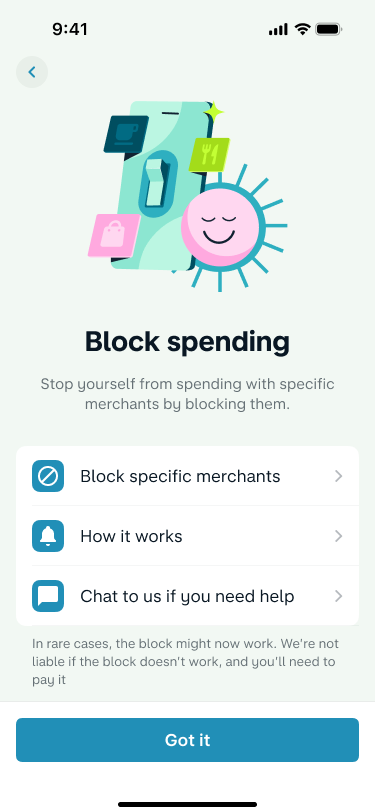
Specific merchants, not whole categories
Inconsistent merchant categorisation ruled out reliable category-wide blocks.
Helping customers put a boundary between an impulse and a purchase—on their own terms.

Adoption comes from the project retrospective. It doesn’t measure reduced financial harm.
We started with no defined solution. I ran lightning talks and a workshop with vulnerability specialists, designers and researchers.
We turned the evidence into opportunities, then chose what we could act on.
How could we help people interrupt unwanted spending, while keeping the choice in their hands?
Customers chose which merchants to block. We never said a purchase was wrong.
Sharing a reason was optional.
During setup, customers could write themselves a reminder. If they tried to unblock the merchant later, we showed them their own words.
The product creates a moment to reconsider. The customer stays in control.
With one engineer and two weeks, we chose a first release with clear limits.
Inconsistent merchant categorisation ruled out reliable category-wide blocks.
Bank-transfer restrictions needed support-team intervention.
Time-based blocks and a delay before unblocking were outside the first release.